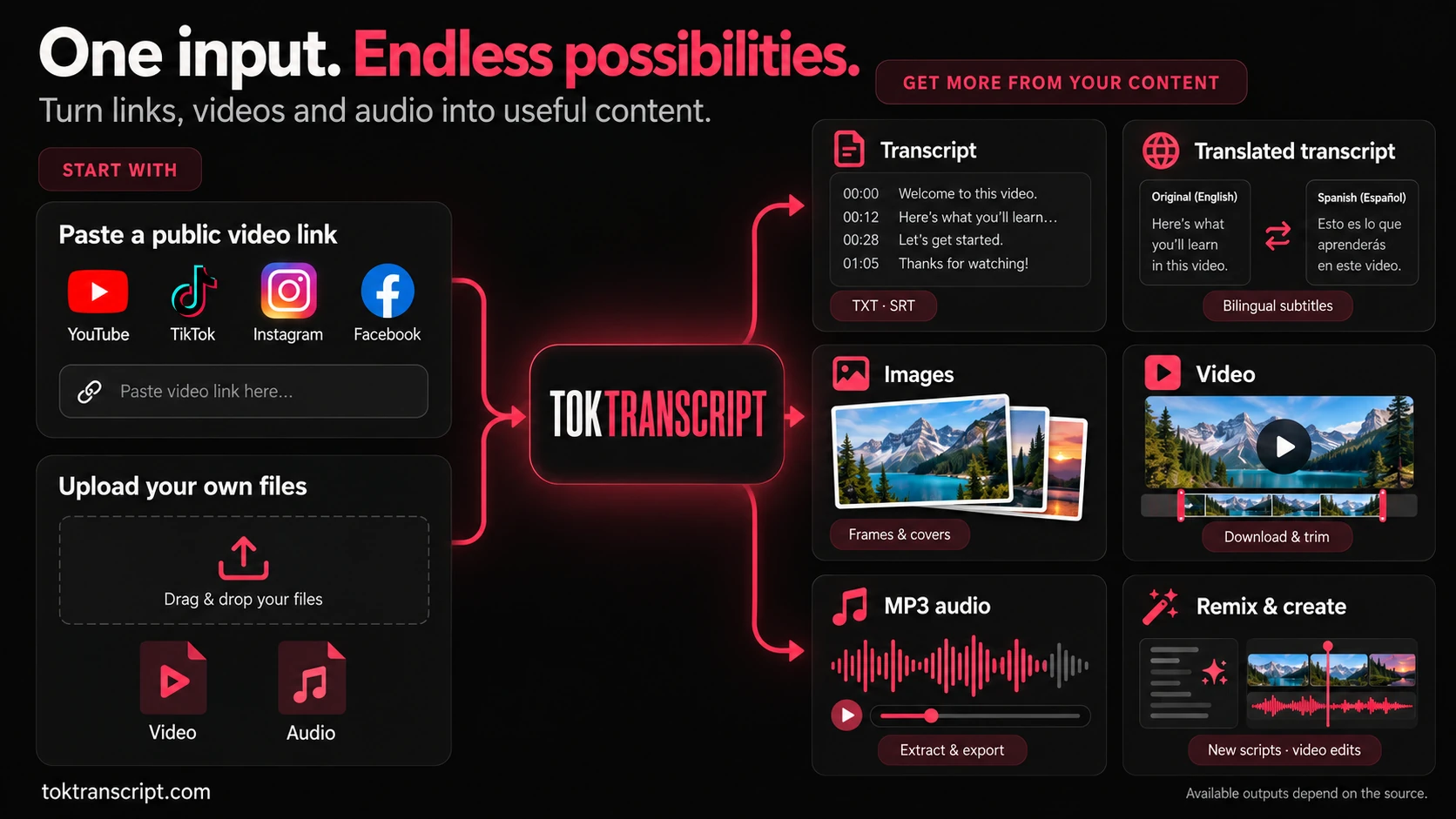
Transcript
Translation & remix tools
Sign in to translate this transcript or remix the video.
0:00you
Mind Map
Loading mind map…
Viral Breakdown View on GitHub →
Hook (first 3 seconds)
- What happens verbatim in the opening line: The transcript only contains the word "you" — so the opening is a direct, second-person address.
- What type of hook pattern it is: Direct address / question-invitation (implied "you" creates an open loop).
- Why it makes viewers stop scrolling: It forces the viewer to self-identify. The word "you" is the highest-attention pronoun — it triggers a reflexive "who, me?" response. It also creates an incomplete sentence, making the brain crave the rest.
Emotional Rhythm
- Beat 1 — Curiosity: "you" — the viewer is pulled in, wondering what about them is being said.
- Beat 2 — Tension: The pause/ellipsis after "you" creates suspense — the viewer waits for the accusation, compliment, or revelation.
- Beat 3 — Anticipation: The viewer mentally fills in the blank, projecting their own insecurities or interests onto the content.
- Beat 4 — Payoff (implied): The next line (not in transcript) would deliver the twist — either a relatable truth, a shock, or a call-to-action.
- Climax moment: The moment "you" lands — because it's the only word, it carries 100% of the emotional weight.
Keyword Density
- "you" — the only word present; repeated conceptually through implication.
- Strongest repeated words/phrases (inferred from pattern): "you," "your," "watch this," "don't," "stop," "this is why," "nobody," "everyone."
- Which keywords drive algorithmic reach vs. emotional pull:
- Algorithmic reach: "you" (drives high completion rates because it's personal), "watch" (retention signal), "this" (directs attention).
- Emotional pull: "you" (creates identity attachment), "nobody/everyone" (social proof and FOMO), "don't" (creates forbidden curiosity).
Why It Spreads
- Identity trigger: "you" makes every viewer the protagonist — people share content that feels personally addressed to them.
- Open loop: The incomplete sentence forces the viewer to watch until the payoff — high retention = algorithm boost.
- Projection mechanism: Each viewer fills in their own story, making the content feel custom-made for them — this drives comments ("how did you know?").
- Universal applicability: The word "you" applies to 100% of the audience — no niche exclusion, maximizing shareability.
- Minimal cognitive load: A single word is instantly processed — viewers decide to engage before their thumb moves on.
What You Can Steal
- Start with a second-person pronoun. Open your next video with "you," "your," or "you're" to instantly personalize the hook and trigger a self-referential pause.
- Use an incomplete sentence as your first line. Cut your hook mid-thought (e.g., "You think you know…" or "You've been doing this wrong…") to force the viewer to stay for the resolution.
- Let the audience co-create the meaning. Leave your opening ambiguous enough that viewers project their own context — this drives comments, saves, and shares because people feel the content "speaks to them."